
Trans History Week 2025
- dunsirep
- May 8, 2025
- 5 min read
By Phoebe Dunsire
This year, amidst the culture wars using trans folk as scapegoats across the world, it is important to mark Trans History Week. It is essential to remember that our identities are not a “new fad”, something to be marred as a modern trend that has grown out of “woke” culture amongst young people.

Trans people have always existed. Our existence is both ancient and modern, and our history is important. It is possible to trace trans identities way back into Native American and Aborigine cultures from long before modernity, but this year, to mark Trans History Week, I have chosen to focus on a couple of figures from more recent history. Two figures whom, I learned as I researched this post, have stories that are inextricably linked: Roberta Cowell and Michael Dillon.
Roberta Cowell, born in 1918, was the first publicly known person in Britain to undergo gender reassignment surgery in 1948. Prior to her transition, she had been a race car driver and had competed in the Grand Prix, making her a figure in the public eye. She enjoyed a semi-successful career in racing, before deciding to join the RAF and becoming a fighter pilot during the Second World War, flying Spitfires.
In 1941, she married Diana Carpenter and together they had two children, Anne and Diana. But a couple of years after Diana’s birth, one of her missions over enemy territory was compromised and she spent six months as a prisoner of war, held by the Nazis in Stalag Luft III. She was liberated by the Red Army in 1945 and returned home, seemingly with a new lease of life and a new understanding of herself.
In 1948, Cowell separated from her wife and sought out the help of a psychiatrist who, according to her autobiography, confirmed that her “unconscious mind was predominantly female”. After this, she was examined by a Harley Street sexologist who claimed that Cowell showed some undoubtedly feminine sex characteristics, such as wider hips and narrower shoulders than one would “typically expect” of a man. It was around this time that Roberta Cowell began hormone therapy, officially starting her medical transition.
It was around this time that Cowell met Michael Dillon, a trans man in the process of medically transitioning, whilst also himself training to become a doctor. Understanding her predicament, he fully supported her desire to transition and agreed to perform an illegal orchiectomy on her so that, later, when she went to a gynaecologist, she could be classified as intersex and re-issued a birth certificate classifying her as female. From here, to continue the journey of her transition, she was introduced to the pioneering plastic surgeon, Harold Gillies. In 1951, Roberta agreed to undergo the first MtF gender reassignment surgery, in a process of Gillies’ design.
In March 1954, Roberta did a paid interview with Picture Post (a popular magazine in Britain at the time) and made the front page, becoming well-known across the nation as the first publicly out transgender person that most Brits had ever heard of. After this, she continued motor racing for a short period, winning the Shelsey Walsh Speed Hill Climb in 1957, but she was banned from participating in any Grand Prix, preventing her racing career from progressing and tanking the publicity of her racing car engineering company, which had to cease trading.
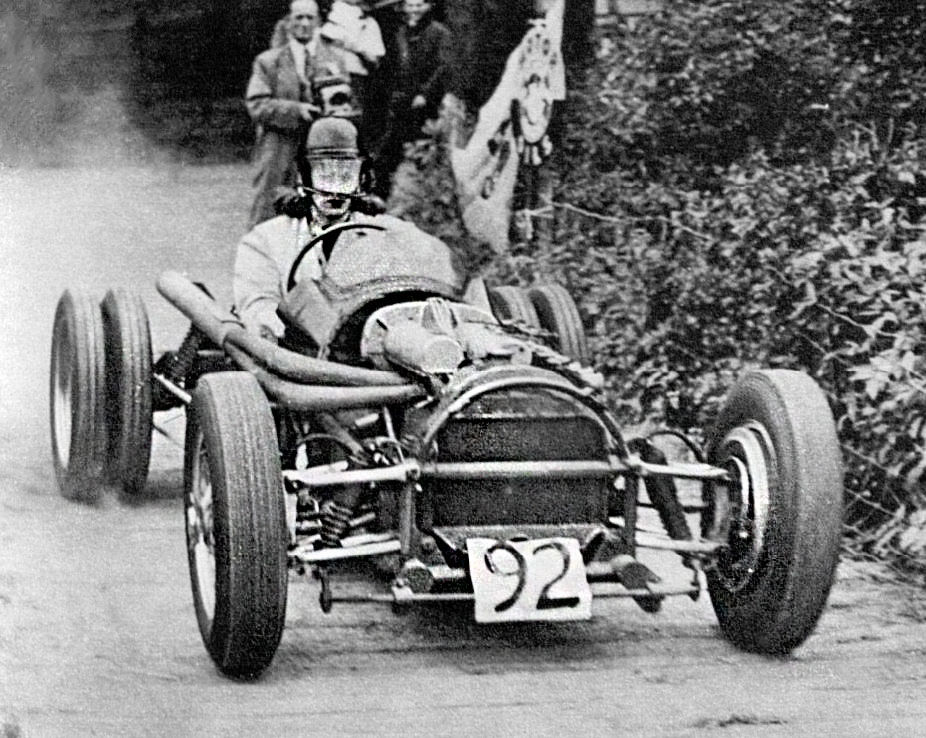
Having essentially been regarded as some sort of medical experiment by the general public, Cowell eventually left the limelight and lived a quiet life until her death in 2011. She saw a huge change in the way that the trans community was viewed by the public during her lifetime, but she also will have recognised a concerning number of consistencies in the way that transgender people were treated and regarded between the 1950s and the 21st century.
Running historically parallel to Roberta Cowell’s story, Michael Dillon, born in 1915, was the first transgender man to undergo gender reassignment surgery. Born in 1915, Dillon was raised by his aunts in Kent, England. He excelled in his studies and, after school, attended St Anne’s College, the women’s college at the University of Oxford, where Dillon would embrace his masculine side as a member of the collegiate rowing team.

He graduated and began working at a laboratory in Gloucestershire, where, in 1939, he sought the advice of George Foss, a scientist who was experimenting with testosterone. Foss said that he would provide Dillon with testosterone on the condition that he saw a psychiatrist to confirm that it would be the right decision for him. Michael saw the psychiatrist that Foss recommended and was given testosterone.
But the psychiatrist outed Dillon to the supervisor of the lab, resulting in the termination of Dillon’s employment and forcing him to move to Bristol, where he became a driver and a nightwatchman for a local mechanic. Whilst the cause of his move to Bristol was upsetting, Dillon had never been known in Bristol as anything other than a man, especially now that the testosterone was taking effect, and he was beginning to see muscle growth and grow facial hair. Here, he managed to change his birth certificate, officially becoming Laurence Michael Dillon, on the record.
The doctor who signed these identity documents for him, Dr Geoffrey Fitzsimmon’s, also provided Dillon with a mastectomy (now commonly known as top surgery) in 1943, alleviating a huge source of his gender dysphoria.
It was around this time that Fitzgibbon’s introduced Dillon to Dr Harold Gillies, who would also go on to perform Cowell’s transition surgeries. Over the next six years, Gillie’s performed a series of 13 surgeries on Dillon, including the world’s first phalloplasty. The surgeries took place over such a long period because of the demand for Gillies’ plastic surgery prowess for soldiers during the war. Dillon, however, was not perturbed and used this time to enrol at Trinity College Dublin, where he trained as a doctor. He completed his medical transition and his university training in 1951, the same year that he proposed to Roberta Cowell, believing that because of their shared experiences and mutual understanding of the world, they could be very happy together. She turned him down.

Presumably suffering from this rejection and wanting a change of scenery where no-one knew of his particular circumstances, Dillon joined the Merchant Navy as a ship’s surgeon. He thrived in such a masculine environment, living as his authentic self.
But this was cut all too short when, in 1958, he was tracked down by tabloid journalists, who wrote an article about him in the Sunday Express. His navy days were forcibly ended, and when he later reflected on this, he said “Here was the end of my emancipation!” He told his captain that he would be disembarking at Kolkata and spent the remaining years of his life there, studying Buddhism and writing poetry, philosophical texts and his autobiography. After Dillon’s death in 1962, it is believed that his brother hid this autobiography from the world, meaning that it was not recovered and published until 2017.


Comments